Does Going Gray Reduce "Twitchy Phone Checking?"
When I started becoming conscious of my phone use back in May of 2017, I wanted to make sure I approached it as a scientist. Methodical, measurable, repeatable. I measured every variable I thought necessary: phone use duration, screen on/off time, specific app usage, phone check frequency. That last one is what I'll break down today.
To quote the recent, very popular piece from the New York Times on gray scaling phones:
"I've been gray for a couple days, and it's remarkable how well it has eased my twitchy phone checking, suggesting that one way to break phone attachment may be to, essentially, make my phone a little worse. We're simple animals, excited by bright colors, it turns out."
The author, Nellie Bowles, suggests that a grayscale phone has reduced how often she checks her phone. That's a question I asked myself a lot. Going gray has massively reduced my phone use time, but how has it affected how often I check my phone?
Why is phone check frequency important? I started thinking about it after reading a paper published in the Addictive Behaviour Reports journal (Lin et al., 2017). The authors concluded that for smartphone addiction, frequency of phone checks was a more important metric than phone use duration when diagnosing smartphone addiction. According to their research, checking your smartphone greater than 68.4 times a day is indicative of addictive smartphone behaviour. One of the hallmarks of any addiction is impulsive behaviour. In the case of smartphone addiction, the twitchy phone checks is how users get their "hit."
This by no means is a rigorous study with a large sample size. This is an analysis of my experience with grayscale and the changes in behavior that it produced. What this does offer is some insight on the effects of grayscale using real data. That has always been the motivation and the goal of gogray.today: to let data drive the narrative.
Before grayscale: 137 per day
May 21 - July 21, 2017
After grayscale: 107 per day
July 22, 2017 - January 21, 2018
Quick context for those that haven't read the first post about grayscale reducing phone use time. I used App Usage to record my phone activity, starting May 21, 2017. I discovered grayscale mode July 21, 2017.
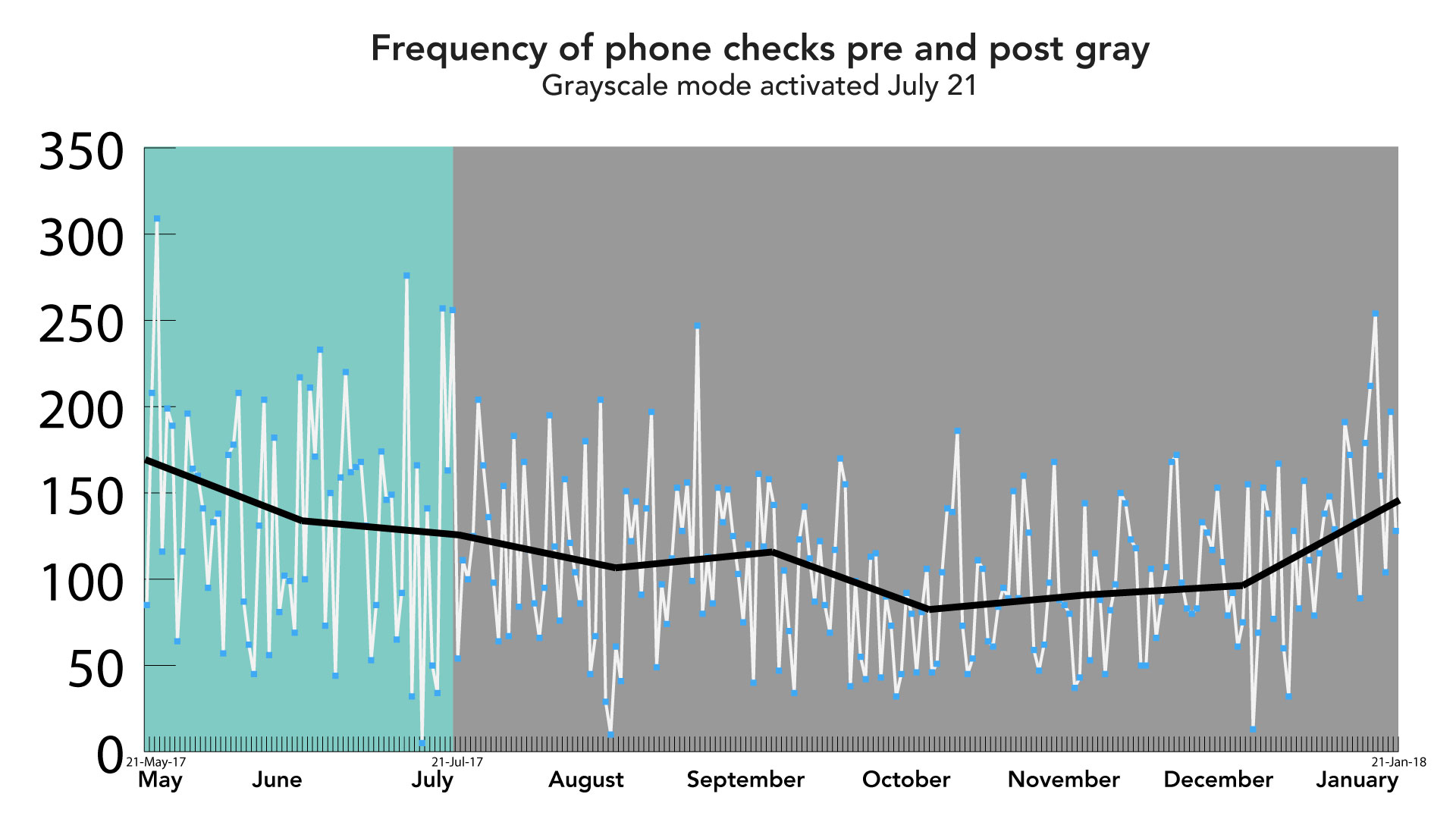
Before grayscale (May 21 - July 20, 2017), I checked my phone 137 times on average (n=62 days). The average for post-grayscale (July 21, 2017 - January 21, 2018) was 107 (n=182 days). That's about a 22% decrease in phone checks. However, after conducting a paired T-test, the P value was greater than 0.05 (P = 0.0546). In other words, the difference was not large enough to be statistically significant.
Can grayscale help with sporadic phone checking? It appears to help a little, and it definitely can't hurt. But if someone came to me with the concern that they can't control their twitchy phone checking and have no issues with how much time they spend on their phone, would I recommend grayscale as the solution? Probably not.
Here's how I would explain the 22% reduction. Every time I unlock my phone, I see a gray screen. The next thought in my brain is: "Why am I checking my phone?" If I had a purpose to unlock it, I proceed. If it was an unconscious phone check, I put my phone back down. Repeat that thousands of times over months, and I start to check my phone less and less. My neurons are being trained to become more conscious of checking my phone.
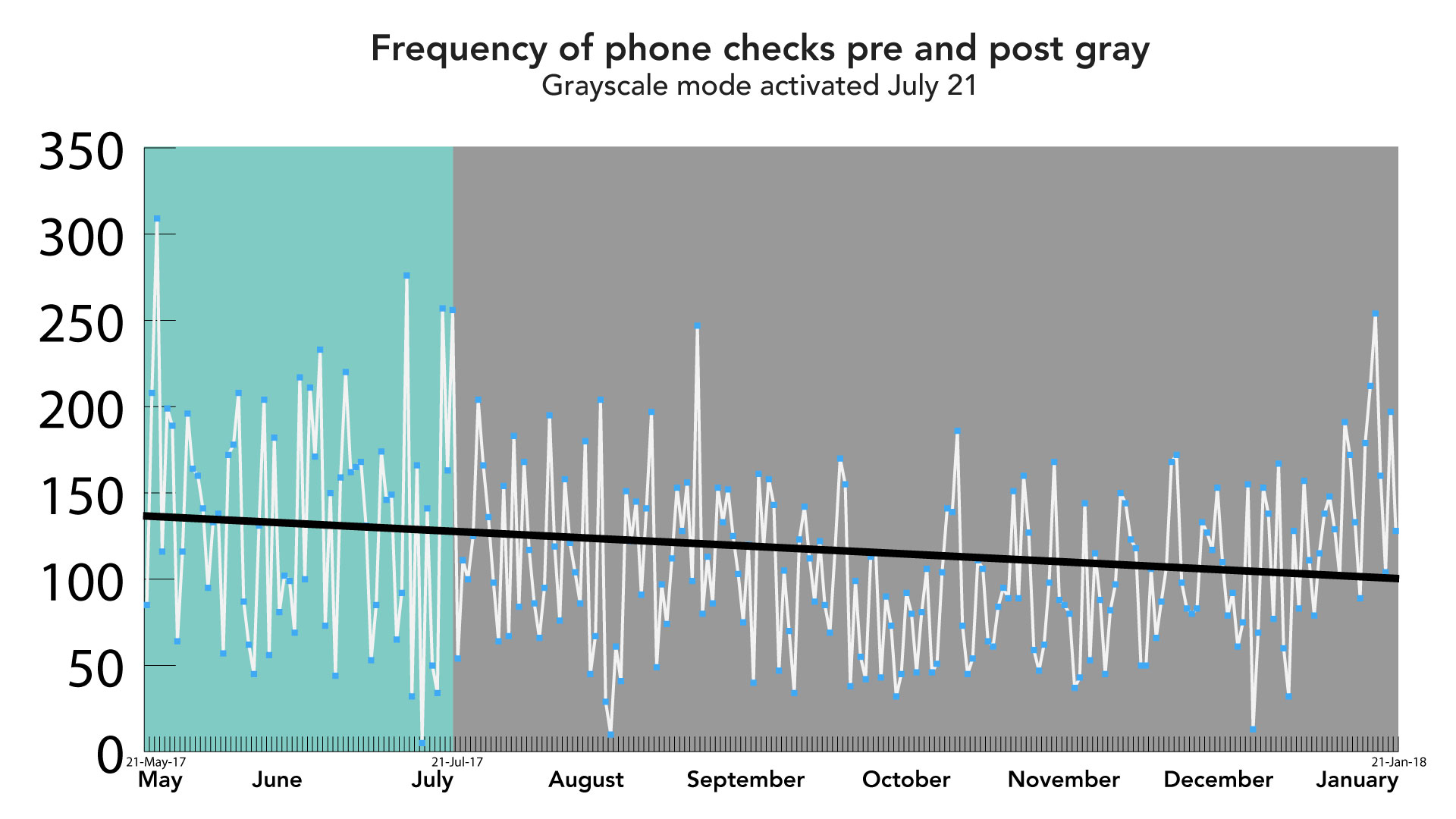
There is a downward trend in my phone check frequency data. It only shows up in the long-term, as my behaviour changes over months. Ultimately, it's still too early to say what the full benefits of going gray really are.
The point of gogray.today isn't to reduce phone use numbers to below an arbitrarily set threshold. It's to redefine the relationship we have with our phones. What that looks like for you is different than what it is for me. You get to define that. Nobody else.
What I can say is this: it takes months for grayscale to affect how often you check your phone; but for most people, time spent on your phone is reduced the moment you go gray. Both are good, but I think grayscale solves the "time spent on your phone" problem really well. Everything else it does after that is just a bonus.
Get notified when the Go Gray App launches
Shortcuts and automations for Grayscale, plus usage stats.